Human-in-the-Loop AI: Why Approval Workflows Matter for Email
Imagine an AI email assistant drafts a response to a client complaint, and it sends automatically without anyone reviewing it. The AI's response is factually accurate but misses the emotional context. It comes across as cold and dismissive. The client relationship deteriorates. Or consider a marketing team where an AI tool sends an internal email with a confidential product roadmap to the wrong recipient. No one catches it because the sending happened instantly, autonomously.
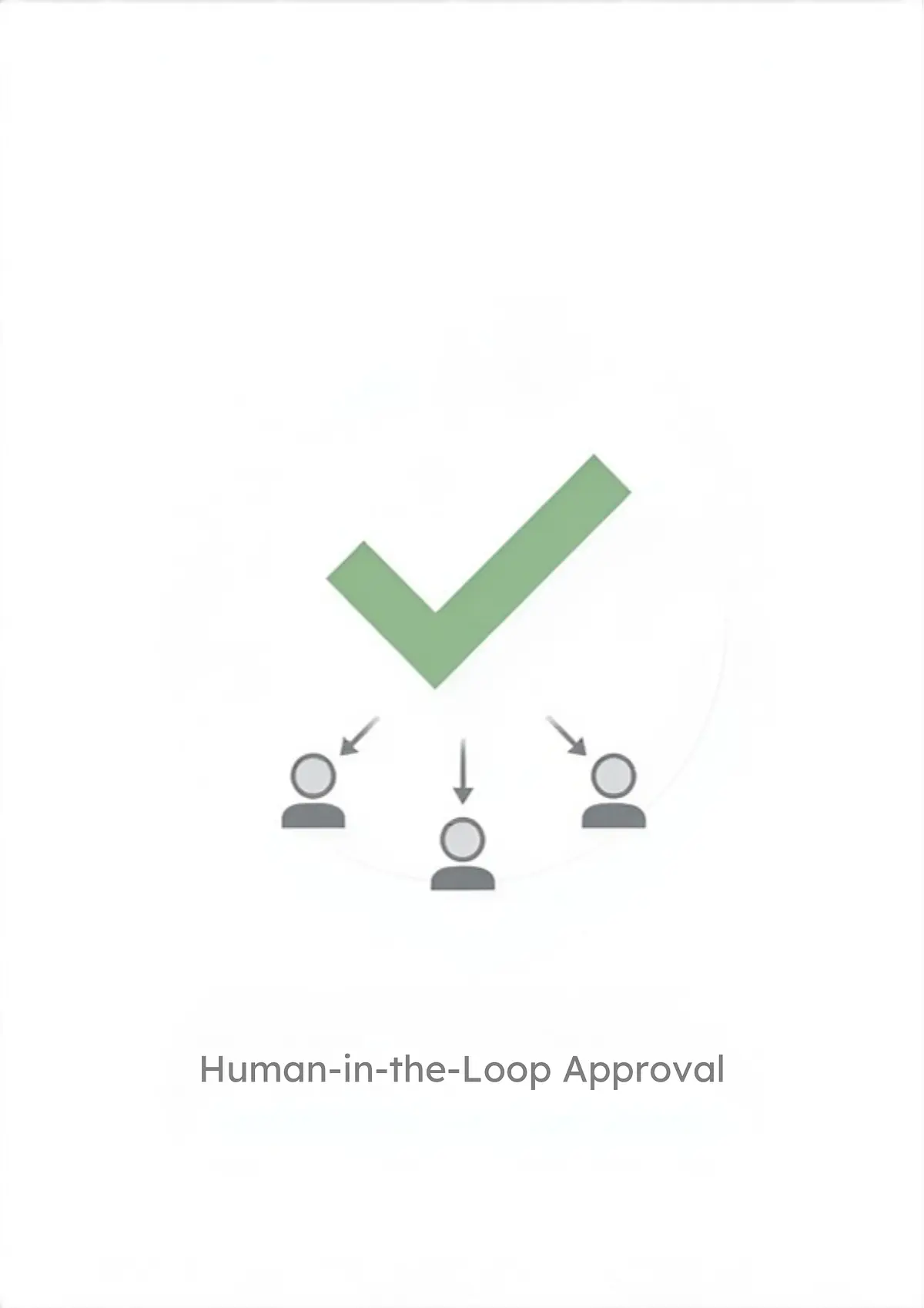
These aren't hypothetical risks—they're the dangers of fully autonomous AI in email. This is why human-in-the-loop (HITL) AI matters. HITL means intentionally adding human oversight at critical decision points in AI workflows. Instead of letting AI operate with full autonomy, you build in checkpoints where humans can review, approve, reject, or provide feedback. It's about finding the balance between automation's efficiency and human judgment's wisdom.
Defining Human-in-the-Loop
Human-in-the-loop AI is a design pattern where human intelligence is embedded into various stages of AI operations. Rather than designing AI to make decisions and act autonomously, HITL systems create explicit touchpoints for human review and intervention.
In the context of email, HITL might work like this: an AI assistant drafts a response to a customer email. Instead of sending it immediately, it routes the draft to the assigned team member for review. The team member can approve it as-is, edit it, or reject it. If confidence scores are low or the email contains unusual patterns, the system automatically flags it for review. Each approval becomes training data that improves the AI's future performance.
The key insight: HITL isn't a weakness or a sign that AI failed. It's a deliberate design choice that makes AI systems more reliable, safer, and more aligned with human values.
Why HITL Matters for Email
Email carries professional and reputational risk. A single inaccurate email can damage client relationships, expose confidential information, or create legal liability. This is why human oversight is critical.
Accuracy: AI can misinterpret context. A customer email that seems like a complaint might actually be a joke. A request for information might actually be a probe for confidential details. Human reviewers catch nuances that AI misses. When an AI drafts a response, having a human review it catches errors before they reach the client.
Brand Voice: Your email communications carry your brand voice. An AI might draft technically correct emails that sound robotic or off-brand. A human reviewer ensures emails sound like they came from your company, with the right tone and personality.
Compliance and Risk: Some emails touch legal or regulatory sensitivities. A response about a customer complaint might need careful wording to avoid admissions of liability. An email about a sensitive business negotiation might reveal too much if worded carelessly. Human judgment catches these risks.
Relationship Continuity: Email is relational. The right response depends on history—what was said in prior emails, what's the status of the relationship, what commitments have been made. AI systems can access this context, but human judgment about how to navigate it remains essential.
Ethical Judgment: AI doesn't have ethics—humans do. If an email response would be technically accurate but ethically problematic, a human catches it. If an AI wants to escalate an issue in a way that would damage a customer relationship, a human prevents it.
Practical HITL Patterns for Email
There are several ways to implement HITL in email workflows:
Approval Flows: The AI drafts or summarizes, and humans approve before sending. This works well for AI-generated responses to customers or important internal communications. The human can review, edit, and approve in seconds if the AI did a good job.
Confidence-Based Routing: The AI includes a confidence score with its output. High-confidence items (routine emails, clear patterns) might not require review. Low-confidence items (unusual situations, ambiguous requests) automatically route to human review. This balances efficiency with oversight.
Escalation Paths: The AI handles routine emails, but complex or sensitive emails escalate to humans. An email containing certain keywords (legal terms, financial figures, customer complaints) automatically routes to a supervisor rather than being handled autonomously.
Feedback Loops: Humans review AI outputs and provide feedback. This feedback trains the AI. Over time, as the AI learns from corrections and approvals, the need for intervention decreases.
Audit Logging: All AI actions are logged and auditable. If a problem occurs, you can see exactly what the AI did and why. This creates accountability and helps with compliance.
A real-world example: A support team uses an AI tool to draft responses to customer emails. High-confidence routine questions (order status, shipping inquiries) are drafted and sent with a brief notification to the support agent that they can review if needed. More complex inquiries (complaints, special requests) are drafted and routed for approval before sending. If customer sentiment is detected as negative, the escalation path routes to a supervisor. Each approval feedback trains the system, reducing future need for intervention.
The Business Case for HITL
HITL slows things down slightly. It adds a human decision point that might take a minute or two. But the benefits often outweigh this cost:
Risk Reduction: Preventing one catastrophic email mistake—sending confidential information, responding inappropriately to a complaint, missing a legal nuance—pays for months of HITL overhead.
Improved Customer Relationships: Humans catch tone, context, and relationship nuances that AI misses. This means better customer interactions.
Regulatory Compliance: For regulated industries, HITL provides the oversight and audit trails that regulators expect.
Model Improvement: Each human correction trains the AI. Over time, HITL systems get smarter and require less intervention.
User Trust: When users know a human will review AI outputs, they trust the system more. This increases adoption.
Ethical Safeguards: HITL creates space for ethical judgment that pure automation can't provide.
For organizations overwhelmed by email volume, HITL doesn't mean handling every email manually. It means automating 80-90% of routine work and having humans focus on the 10-20% that matters most—the emails where human judgment adds real value.
Implementing HITL in Your Organization
If you're considering HITL for AI email, here's how to start:
1. Identify High-Risk Categories: Which emails carry the most risk if handled incorrectly? Customer responses? Legal communications? Executive emails? Start with those.
2. Design Approval Workflows: Map out who needs to approve what. Does every customer response need approval, or just certain types? Can the same AI learn to handle routine questions autonomously while routing complex ones?
3. Set Confidence Thresholds: Determine what confidence score requires human review. This prevents the system from flagging every email while still catching uncertain decisions.
4. Create Audit Trails: Log all AI actions. Track approvals, rejections, corrections. This creates accountability and provides training data.
5. Train Team Members: Make sure the humans doing the reviewing understand their role. They're not just checking boxes—they're training the AI with their decisions.
6. Start Small: Don't implement HITL across your entire organization at once. Start with one team, refine the process, then expand.
7. Monitor and Adjust: Track metrics. How many emails require review? How long does review take? How often are AI outputs rejected? Use this data to optimize.
Addressing the Friction Problem
The main criticism of HITL is that it reintroduces human bottlenecks. If every AI output requires approval, you've just created more work, not less.
The solution is intelligent approval workflows. Not every email needs a human. Routine questions with high confidence scores can proceed without review. Complex emails, low-confidence situations, and flagged items need attention. This hybrid approach captures most of automation's benefits while maintaining oversight where it matters.
One financial services firm that implemented HITL found that 78% of customer emails were handled by AI without human review, 15% required a quick approval (30 seconds), and 7% needed detailed human attention. This still represented massive efficiency gains over purely manual handling, but with human judgment on the decisions that matter most.
The Future of Human-AI Collaboration
The goal isn't to replace humans with AI or to maintain full human control. The goal is collaboration—leveraging AI's ability to process information at scale while preserving human judgment where it's essential.
As AI systems improve and receive training feedback from HITL workflows, they require less intervention. But there will always be decisions where human judgment adds value. Complex negotiations, ethical dilemmas, relationship management, and strategic decisions benefit from human involvement.
The professionals who thrive in an AI-assisted world won't be those who resist automation. They'll be those who learn to work alongside AI, reviewing its recommendations, providing feedback, and focusing their own effort on the decisions that require human wisdom.
HITL is a bridge between pure automation (which is often risky) and no automation (which is inefficient). It's a practical framework for getting benefits from AI while maintaining the human oversight that makes the system trustworthy, compliant, and effective.
Your email is too important to leave entirely to machines, but too voluminous to handle entirely by hand. Human-in-the-loop AI is the pragmatic middle ground that lets you have both: the efficiency of automation and the judgment of humans.